Geeks On A Beach (GOAB) surfs its way back to Boracay Island this August for its third year of gathering tech startups, technopreneurs, businessmen, and designers from all over the world.
“Also known as the International Summit for Tech, Startups and Design, GOAB 3 eyes to create productive discussions on building products that make a difference and enhancing the lives of everyday people with less hype but more action,” said Tina Amper, TechTalks.ph founder.
With the past two years’ massive success, GOAB returns with a triple splash this coming August 20-21 which means triple number of innovative minds, triple funding opportunities, and triple dose of fun.
Amper confirmed the attendance of 17 tech champs so far to speak before an expected 600 to 1,000 participants from across the globe.
Some of the speakers include IdeaSpace President, Earl Valencia; Monk’s Hill Ventures Managing Director, Kuo-Yi Lim; Kickstart Ventures President, Minette Navarrete; Rappler CEO, Maria Ressa; SMART Communications Developer Evangelist, Paul Pajo; Department of Science and Technology-Information and Communications Office (DOST-ICTO) Deputy Executive Director, Mon Ibrahim; and 500 Startups Managing Partner, Khailee Ng.
“GOAB will be maintained as an ‘honest-to-goodness, no holds-barred conference’ where people exchange their share of truths about startups, technology, and design—minus the long sleeves, coat and tie,” said David Overton, founder and CEO of Sym.ph CEO, and Chief Geek for GOAB.
Two days are set aside exclusively for the main event but in a span of one week; all geeks are welcome to join the week-long run of workshops, training sessions, networking opportunities, pitching events, and product demonstrations with or without their flip-flops on.
Boracay Island, being one of the best islands in the world, sets a relaxing background of what is usually thought as an intense and stressful conference.
OrganizersTechTalks.ph and the DOST-ICTO have partnered once again with Sym.ph, Happy Garaje, and PRWorks Vis-Min, with major sponsorships by SMART DevNet, IdeaSpace, Microsoft, and Monk’s Hill Ventures.
DOST-ICTO continues to team-up with TechTalks.ph to encourage Filipino startups to get mentoring and funding in the country instead of going abroad.
GOAB is open to anyone who is interested in the tech and startup industries in the Philippines – including those looking for tech and entrepreneurship learning events, business and investment opportunities, outsourcing partnerships, and connection with leaders in startups or “innovation driven enterprises” (IDE) in the Philippines as well as Southeast Asia.
Interested participants are invited to view event details or register at www.GeeksOnABeach.com. Early bird discount is up to 45% off and is valid until May 15 only. Potential sponsors are invited to contact GOAB at hello@GeeksOnABeach.com
TechTalks.ph, organizer of numerous startup gathering in the country including GOAB and Startup Weekend, is a non-profit organization dedicated to educating, supporting, and empowering Filipinos tech entrepreneurs and promoting the Philippine tech sector to the world.
Elon Musk, CEO of Tesla Motors, announced on April 30, 2015 the diversification of Tesla Motors into energy focusing on energy storage solution for home, businesses and utilities. For homes, he announced the availability of their new product called Powerwall, a new battery system based on lithium-ion technology that Tesla Motors have proven to be a reliable and safe solution for its line of electric cars.
Musk said that one of the hindering factors for the adoption of renewable energy for the home is the cost and maintenance complexity of the batteries that need weekly monitoring. There is also a safety issue with conventional batteries because they use corrosive acids that has fumes and possibly become a fire hazard.
Musk said that the US and the world could be powered 100% by renewable energy sources and their new battery technology could be the turning point in adapting such sources.
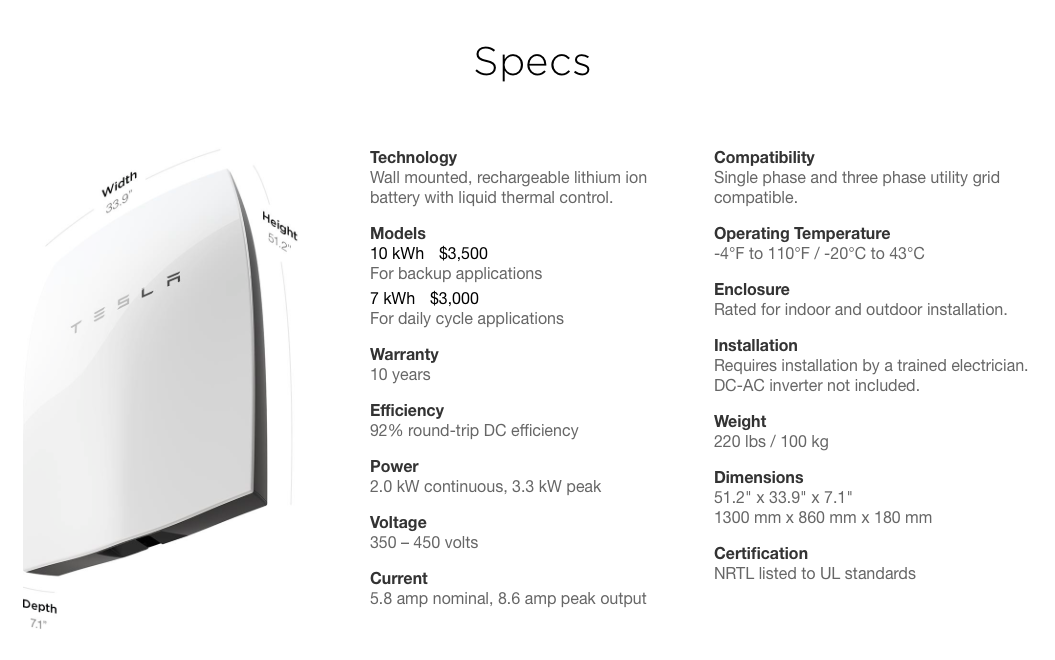
Tesla Energy set the price for the 10KWhr Powerwall at $3,500 which brings the cost of storage to $350/kWhr. The Powerwall is guaranteed to operate for 10 years with no maintenance. In contrast, a lead-acid battery with 100AH capacity at 12 volts (just a bit more than 1kWhr capacity) costs PHP7,500 or about $170. You are lucky though if it could last five years with daily charge/discharge cycles. So if you consider that lead-acid batteries may be replaced at least twice in a 10-year period, then the Powerwall is nearly the same price. And because there is no maintenance required, the Powerwall is really an attractive option if you want to take advantage of renewable energy sources such as the sun and wind.
A year and a half ago, I started a series of articles detailing my experiments with solar energy production and storage towards my goal of a 24×7 operation of our office at Auza.Net on solar energy. My existing system of 300W with 2kWhr storage capacity has helped saved some energy cost and it has powered our minimum load at the office during daytime power interruptions.
With Tesla Energy’s Powerwall storage solution, the future of renewable energy use is really bright. On top of the Tesla motors has made all its patents open source so if other energy solution ventures take advantage of it, the cost of converting to renewable energy would go down even more in the foreseeable future.
Powerwall specs (screen grab from www.teslamotors.com)
It’s highly likely that you may have heard about cloud computing and how it is improving business processes. If you haven’t heard about it, chances are, you have been using cloud based services already. The popular social network websites extensively use cloud technologies to deploy their services.
If you are an SME in Bohol, would you consider running some of your business processes on the cloud? You probably should. From a cost perspective, it will might sense. For example, to implement an accounting system, the usual solution is to buy a server computer. Server grade hardware can cost upwards of Php60,000.
If you need the services to run 24×7, you need to have a backup battery, a backup generator and of course, you need to pay for the electricity cost. You probably also need to put air conditioning system to keep the server cool. And if you need users to access the server remotely, you need to have an Internet connection service with large upload bandwidth. Lastly, you need to perform backups and deal with hardware failures.
In contrast, deploying a cloud server doesn’t have any large upfront cost. Instead, there is a flat monthly rate for the server and a variable cost for the amount of data transferred from the server to the users. A cloud server with 4 GB RAM, 120GB storage and dual core cpu can cost between Php5,000 to Php10,000/month depending on the hosting company you use.
For SME use, smaller servers may do. I have used 256MB RAM, 10GB servers that cost about $15/month for a simple application that needs to be running 24×7 but doesn’t need to have powerful computing resources.
The data center keeps all the computer hardware running thus the user simply needs to focus on his application.
Many business systems, such as ledger systems, can be deployed on the cloud. I have implemented several cloud based solutions for real-time recording of financial transactions which allowed the business owner to keep track of his business conveniently.
In a multi-branch company, a cloud solution may be the only cost effective solution. By putting the central accounting system on the cloud, branches simply perform transactions on the cloud server. If the Internet connection of the headquarters is down, the branches can still continue to transact on the cloud server.
Youtube founder Jawed Karim uploaded the first video called “Me at the zoo” on Youtube on April 23, 2005. At present, the site has a billion active users and 300 hours worth of video is uploaded every minute. Youtube was acquired by Google in an all stock $1.65B deal late in 2006.
Still at number 1 position for most watched videos is Gangnam Style by Korean rapper Psy. It was the first video to hit the 1 billion and 2 billion marks. It is currently at 2,312,707,145 views while this article is being written.
Youtube is one of the superstar startup success stories in the last decade. Amid copyright concerns, Youtube was able to successfully work with stakeholders in the media industry.
At present, the video sharing service has made been instrumental in launching careers of many stars like Charice Pempengco and Ariel Pineda. Youtube is also enabling ordinary people to do business by producing video content and earning from the advertising service.
We are all familiar with the electrical outlets that are normally found on the walls around our houses and offices. Because of the lethal effects of touching a live electrical wire, we literally have no choice but to wire our electrical outlets properly and using outlets fixed on the walls.
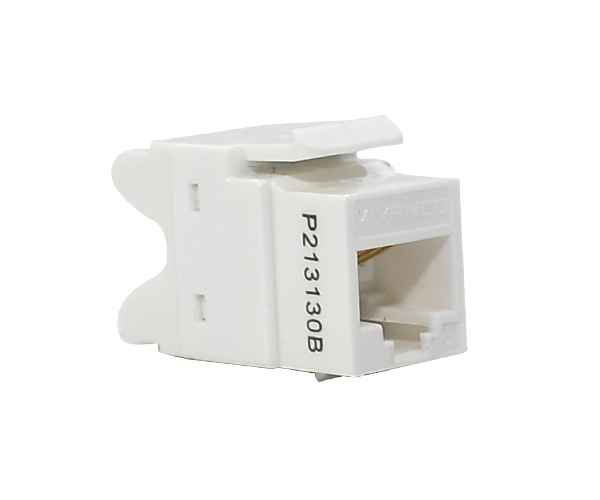
Data outlets that are fixed on walls or tables should be used when implementing a computer network. But unlike electrical outlets, there is no danger of users being electrocuted. Rather, the reason for using data outlets is to ensure that the part of the network from the rack to the data outlet is fixed on the building structure. This offers long term reliability of the network. The user will just need to use a patch cord to connect the computer or other devices to the data outlet.
Untrained installers sometimes just connect computers directly to the network switches using a long patch cord. This is bad practice since it can easily lead to “spaghetti” network where the cables become so organized as the number of network connections increase.
In office environments, some users may need to have both telephone and a computer network connection. Fortunately, cabling for computer networks will work for telephone connections also so two data outlets per user is ideal. The user will have flexibility of using one of the network ports for the computer. The other is for telephone or another device to be connected to the network such as VOIP phones to connect to IP-PBX systems.
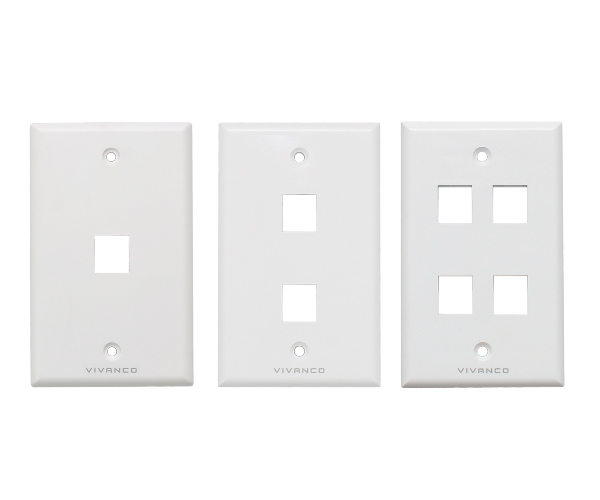
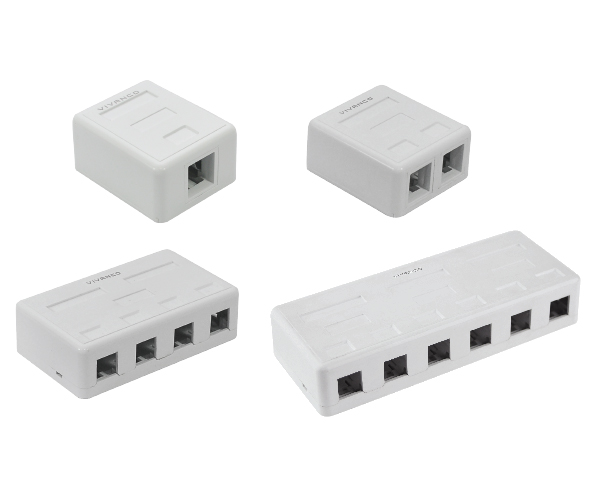
Data outlets may be installed in 1-gang, 2-gang, 4-gang or 6-gang configurations. For office applications, 2-gang installations per workstation is ideal.
Faceplates available in 1-gang, 2-gang and 4-gang configurations.
Surface mount boxes for use when it is not possible to embed a circuit box. Available in 1-gang, 2-gang, 4-gang and 6-gang configurations.
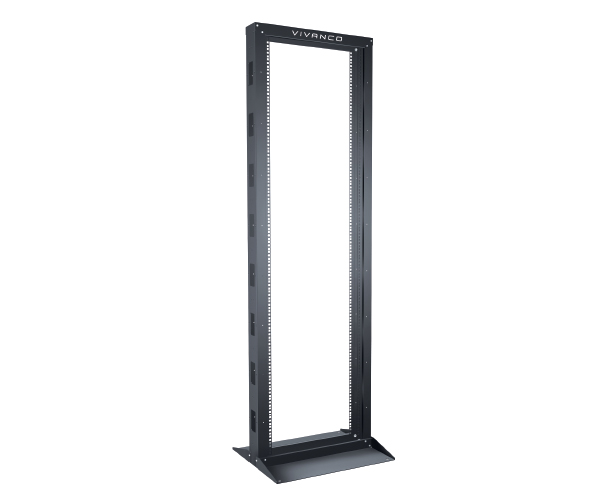
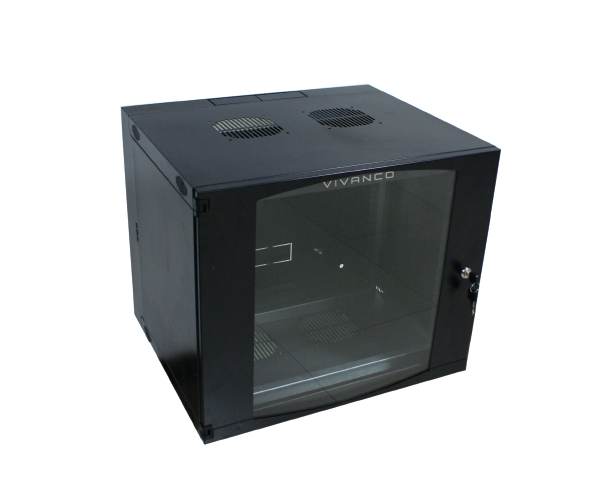
In a computer networks, it is important to organize the part of the network where all the cables converge to connect to the switches and routers. Data cabinets or open racks may be used for this purpose. The choice between a data cabinet and an open rack depends on the location and security requirement.
An open rack allows for convenient maintenance but because the cables and equipment are exposed, it is not ideal for implementations where the rack is in an open area. It would be useful for a dedicated communications room where access is restricted to authorized personnel only.
Data cabinets, on the other hand, will allow for a secured central location of the network even in an open room. There are various options for data cabinets like: heavy duty, with glass door, with ventilating fans, among others. They also vary in height and color.
Racks and cabinets have precision cut perforations where shelves, cable managers and rack mount equipment may be installed. This is important so that the cables and devices would be mounted securely.
When implementing a structured cabling project, even a small one, the use of a rack or cabinet must be considered for a reliable and robust network operation.