by admin | Jul 25, 2019 | Headlines
Department of Agriculture (DA) Regional Director for Central Visayas, Atty Salvador Diputado called for Boholano legislators’ help in rallying Boholanos to rescue the dire need for food security amidst dreams of becoming a major tourism destination in the country.
Speaking during the opening of the Sandugo Agri-Fair 2019 now occupying the Bohol Agricultural Promotions Center (BAPC) and the City Hall grounds, Diputado began his appeal for legislators to do something about the present predicament, with a brief comparison with Korea.
The aggie official who is a lawyer by profession but has a background in agriculture, his family being engaged in rice and cacao farming in Carmen, said in Korea, where there is a surplus of rice, the people keeps even the last bit useful.
He narrated that when he was there, the burnt rice on the bottom of the pot becomes the roast coffee that goes with the breakfast.
In the Visayas however, where there is rice shortage, there is so much wastage, he remarked.
While Bohol is the only province in Central Visayas that can almost sufficiently feed itself, much of Bohol’s surplus is wasted, as an estimated three spoons-ful of rice for every Boholano is wasted every day.
At the Sandugo Agri-Fair opening, agriculture authorities who united to campaign for curbing rice wastage put in Panatang Makapalay, a pledge for citizens to conserve rice.
And to press on the matter even further, the DA regional Director shared the complicated truth: the average age of farmers in Bohol is now at 59, and fewer and fewer young people are going to farming.
“There is actually a move to save the farming industry,” Diputado told representatives of the towns bringing their local produce to the Agri-Fair.
All elementary and high school graduating students must engage in school gardening and entrepreneurial skills, he said, and this can only be through an ordinance.
Diputado wants something like an elementary pupil and a high school student to graduate only if he has planted a garden and earned from it.
The lawyer turned agri-chief in Central Visayas also bared that he is with Governor Arthur Yap, who advocates for food consumption quantification program.
Governor Yap, who used to sit as Agriculture secretary and a hard core economist, meant that by food consumption quantification program, it is scientific and evidence based information on the average daily consumption as the sum of the food requirement of everyone in Bohol. This would become the basis for the production targets in the island.
Once we meet our food requirements, then we can meet our food security, Diputado said.
Moreover, the regional director said something must be done about the fast conversion and reclassification of agricultural lands into residential areas.
According to Diputado, agricultural lands are shrinking, people are shunning away from farming, the people are wasting rice and farmers are not even using the right technologies to maximize harvest.
Over this, Atty Diputado wants legislators to put up ordinances that would strictly implement the ban on reclassification and conversion, especially of agricultural lots that can still be very productive.
That day, the government through the DA, also distributed farm equipment and machineries in efforts to motivate farmer organizations to boost production.
Handed to peoples’ organizations and farmers associations were floating tillers, hand tractor with accessories, drum seeder, rice combine harvester, rice transplanter-Walk Behind and 4 wheel-drive tractors.
With these, Diputado exhorted the farmer beneficiaries to use the government help to alleviate and lessen poverty incidence in the region.
We will show our love for agriculture, as farming has always been a noble profession, he stressed. (rahc/PIA_7/Bohol)
by admin | Mar 15, 2019 | Headlines
In these times where information plays a critical role in disaster resilience, Tagbilaran City innovates with its unique integrated disaster and anti-crime reporting and monitoring system: enter the Communications Line for Emergency Alarms and Response System (CLEAR).
An information hub that banners a highly visible light emitting diode (LED) board that has the capacity to broadcast announcements and disaster mitigation tips, the CLEAR announcement board which is remotely controlled from the Tagbilaran City Disaster and Risk Reduction Management Office Command Center, can even remotely broadcast localized specific information, like localized disaster mitigation drills, explains City DRRMO chief Gerard Lavadia.
For high priority information, like possibly some evacuation or those needing community mobilization, the CLEAR board installation comes with a siren which can also broadcast loud audio warnings via a public address system and a highly visible flasher for maximum reach.
Things like barangay meetings, events, fire drills, earthquake drills and mass casualty incident simulations to better acquaint the communities of the simulations, these can be pre announced to douse out the panic that could result.
And each CLEAR hub also packs a host of high definition tilt-able closed circuit television cameras than remotely transmits real-time images to the command center.
The cameras can be zoomed and panned to follow through an action, a person in a crime situation and when it is stored in a huge databank or live feeds from nearly a hundred more remote cameras, there is a playback capacity for a better reckoning and crime reenactment to help police investigators determine culpability, Lavadia hinted during this month’s Association of United Development Information Officers (AUDIO) in Bohol on their famed Bisita Opisina into the city Hall’s CDRRMO.
And for emergency situations and where there is a need to call for police, firemen or emergency medical services, in the CLEAR information hub is a yellow phone that directly connects the caller to the emergency hotline inside the CLEAR Command nerve center.
It is as easy as opening the yellow phone’s swing box and picking the phone up. This immediately rings the command center and the hotline phone operator can immediately talk to the caller, Lavadia, who keeps the nerve center with a wall filled with live camera feeds remotely transmitted from the CCTVs, informed the visiting information officers.
And for prank callers?
They won’t simply get away.
According to the CDRRMO, as soon as one picks up the yellow phone, the CCTV camera automatically zooms in on the caller so that the operator can have a direct view of the caller and would know if such were just prank call.
The live camera feeds from the 12 CLEAR disaster information hubs all help prop up the city’s anti-crime and disaster resilience capability, Lavadia said.
In fact, on lost items inadvertently left on tricycles, even if the commuters do not memorize the body numbers, by simply reporting it to the CDRRMO, the duty officers can pull out specific time-stamped video feeds for playback recording the time the tricycle passed a specific CCTV for facilitated tracking.
When a caller requests for any kind of assistance, the CDRRMC can send in law enforcers, vector in emergency responders, or simply direct the caller to the nearest source of help, if only to avail of the service.
Over this, the local PIA in Bohol said, “As local governments are fast putting up measures to make communities disaster resilient, we intend to make sure innovations like this that could be templates for replication of technologies are shared and known to the communities.” (rahc/PIA-7/Bohol)
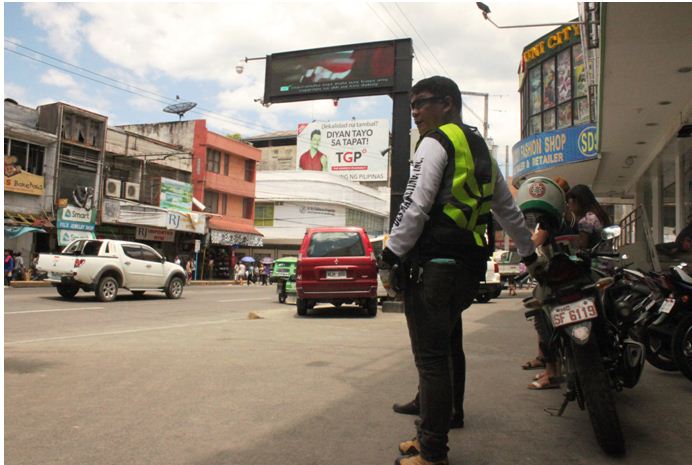
HELP FROM ABOVE. Traffic enforcers station themselves near the CLEAR information hub: a disaster warning system that broadcasts information, one equipped with a flasher, a siren and a public address system, CCTV cameras and a yellow phone that links the caller immediately to the command center in Tagbilaran City. (rahc/PIA-7/Bohol)
by admin | Feb 7, 2019 | Headlines
That ubiquitous ubi solemnly embellishing the popular Pinoy halo-halo, may soon be lost, thanks to a culture that looks down on the hardwork and perseverance of ubi-farmers, being low class, dirty nailed slaves of the land.
Bohol has gained over 200,000 kilos of ubi in the past year, according to data cited by the Office of the Provincial Agriculturist.
The figure however is yet to be shown in the local markets as there have not been much of the 200,000 kilos, enough to flood the markets with the purple or the white yam.
On the 18thUbi Festival here, there is enough reason to believe that ubi could possibly vanish in the next generation.
Here for generations immemorial, ubi has endeared itself to Boholanos, that the crop sits on a pedestal along with some faint objects associated with the pagan animist faith. It is so defined in some family altars during the padogmak (harvest thanksgiving) which also coincides with the All Saints and All Souls day.
But how did the ubi get there?
According to scientific research, ubi(DioscoreaAlatasp) was said to be brought in by THE Austranesian cultures. But the natives have another story for this.
A drought which lasted for months practically killed almost all the food plants. The natives found vines with traces of green or purple towards the roots, and they started digging it up.
Out came the ubi, a food natives believed was provided by the gods of the forest and the gods of the land.
And true enough, it is seasonal and survives towards the last months of the year.
As it is, farmers who have not really been into the industry said the crop is just too delicate to be gambled in. But more importantly, a crop that has attained an ethno-religious elevation is not something to gamble on.
So why is this so?
Domesticated by the natives as a crop which they also introduced to the Spaniards and no sooner, the first ubi made its transatlantic crossing for Europe, to the galleon trades as a exotic product for Europe.
Extensively cultivated from generations, over time, farm families tried to uncover the secrets to a successful pamanlin, anything that adds up to the efforts during harvest they secretly bequeath the folk knowledge on the manner of nurturing the crop, all also knowing that not all farmers are gifted with the hardwork, patience and the perseverance of a saint.
Guarding the secrets like family heirlooms is understandable;with each family picking their own set of perceived beliefs and the resulting harvest.
Cultivated in kaingin patches, ubi is grown from diced tubers, laid in especially dug hutok (holes) laid with a weave of dried leaves, rice straw, banana leaves and sometimes dried sargassum and burning refuse.
And that is getting ahead of the story.
This year, while the OPA reported 200,000 kilos more, farm technicians agree that young farmers, which are fewer, do not put the ubi among their typical options, for several reasons.
Ubi farming is courting failure more than mastering the art of the unknown. And it entails a whole lot of sacrifice, which unfortunately is on bankruptcy levels among younger farmers.
For how could one be as careless when even picking the ubi patch from a secondary growth forest or thick bushes has to be meticulously weighed.
The slope must be considered, ubi thrives in areas where theire is sufficient drainage and water does not gather, this will rot the tubers, a plant disease farmers call as bonggak.
Another consideration is that the patch must have tall bushes that can support the harug (trellis) where the ubi vines can crawl and hang. Primary among the consideration is an abandoned bamboo patch, as the bamboo roots age great aerators. Some also pick abandoned dwellings.
Having selected this, the farmer leaves the area and comes back a few days later to bring an offering to the ‘owners of the land,” one that may be a whole boiled chicken without salt, a roll of tobacco, or anything that may endear him to the spirits so they would allow him to use the land.
Days later, the farmer starts to clean up the undergrowth, carefully leaving some tall shrubs that can be the support for the katayan.
Then he starts digging hutok (planting mounds), carefully digging out the rocks and stones that can wound the ubi. Each hutokcan be a foot in diameter and a foot deep. Mounds cango as much as over a thousand, or a few hundreds.
After completing this, he leaves the farm to gather dried coconut leaves for the hampas. Each coconut leaf, he piles one on top of the other over the entire patch, making sure each mound is covered. This can mean hundreds of dried coconut leaves.
And in one late afternoon after completing laying the dried leaves, he starts burning the coconut leaves from the lowest point of the patch. The fire crawls up and eventually consumes all the dried coconut, leaving some shrubs standing but dead. Burning assured all pests are killed and the ash helps treat the soil.
By the next week, he starts the arduous task of digging out the soil from each mound, replacing it with a good amount of dried banana leaves, a weave of coconut husk, ash, sea weeds, and more dried leaves falling from the burnt bushes.
Meanwhile, in his pinsa or kamalig where he keeps the aerated binhi, he picks the best kinds and uses the sharpest knife to cut diced sitt, about two fingers in width, which would go to each of the hutok. A sharp knife, accordingly would be less harmful as this does not bruise the seedling.
A kilo of guha (diced sitt) can produce over ten kilos of ubi harvest, but that in fact is no stunning motivation to young farmers who would rather dream of some office over the toiling backbreaking and laborious ubi farming.
On one late afternoon, the farmer, sometimes accompanied by the wife, treks to the patch and selects three mounds forming a tripod. He may or ask the wife to plant the first three mounds, carefully invoking the spirits to bless the seedlings, make it as big and possibly one that cracks when cooked. These that cracked are accordingly the sweetest. This is palihi.
A week later, sometime in early May to early June, gathering all these diced sitts to the farm, he, along with a good number of neighbors who join the communal planting called hungos, trek to the ubi patches, this would be timed when the moon is full, and on the waning side and not just anytime.
Some families forbid the farmers from talking too much during the planting, careful not to offend the wounded ubi, carefully laying two sits on the woven coconut husk, or dried banana leaves and then putting in the dug soil back, making sure it forms a mound to drain the rain and keep the sitt from rotting.
When everything is planted, it is now the sole responsibility of the farmer to visit his ubihan and check if the seedlings start to germinate. The moment the green shoots emerge from the mounds, he starts putting up the trellis, which he leans upon the remaining bushes. When this is done, he makes it his daily mid-afternoon to late afternoon ritual to produce some smoke from burning grasses to drive away grasshoppers and pests that feed on the shoots.
Ubi patches during these stages must not be approached, as soon as the shoots are touched, they sulk and won’t grow anymore. The same is true when it is raining or in the early mornings. As the ubi vines start to climb the katayan, care must be exercised so as not to touch them. If in case a harug falls, the farmer must slowly fix the trellis, careful not to wound the vine or affect other plants. Especially by August to September when the ubi would be at its fastest growth rate.
By the last week of November, the farmer goes back to the palihi mound, digs the first three mounds using a wooden panlin, (stake used to dig the ubi)nadthen goes to the last mound planted and also digs the tuber.
These make up the first harvest, and would be forming part of the altar offering, the rest goes to the padogmak, cooked into nilunaw, boiled or simply inanag and displayed uncovered in the padogmak table and left.
Eating these can only happen after each family member returns after visiting their dead. There is the belief that the spirits and the souls of the departed, especially the elder farmers would partake of the food prepared on the padogmak table spread.
The farmer gain returns to the ubi patch as soon as the vine’s leaves start to wilt and dry. This signals the pamanlin season.
This is again another time for the hungos, a communal help scheme where every available farmer helps in the harvest.
The harvesters also make sure they do not just stab the mound and wound or bruise the ubi, each harvest piled and the kids, carrying small bukag (bamboo baskets) gather these to a clearing where the owner keeps tabs of the harvest, an ash bowl on hand and immediately applying a thin paste of ash over the ubi woundor where there is skinning: this cauterizes the wound and stops the karma from the ubi. This also allows the ubi to be stored despite a would that could start the rotting, when unattended, This also goes as payment to the farmers joining the hungos.
When all else is done, the farmer then picks the best harvest, this would comprise the next cropping’s sitt.
And the cycle of life of the ubi starts again.
And this is what the young farmers do not want to be engaged in.
If you now relish on the kinampay and baligonhon, the iniling, binanag, kabus-ok, gimnay, tam-isan and still several other varieties, savor it for it may be getting harder to look for that same homey Bol-anon taste in the next generation. (rahc/PIA-7/Bohol)

Farm technician Guillermo Lupas, 56, of LibjoSikatuna Bohol agree that there is a diminishing number of ubiadoptors, which could drastically reduce the harvest and contribute to the sad fate of the ubi. (rahc/PIA-7/Bohol)
by admin | Nov 18, 2018 | Editorial, Headlines
Just when has power-napping become one person’s problem?
It only becomes one huge problem if you napped and you are Presidente Rodrigo Duterte, who happens to attend the meeting of the heads of states of the Association of Southeast Asian Nations (Asean).
Journalists covering the event reported that President Duterte napped and because of this, missed some of the events laid by the organizers.
Expectedly, like what most people believed, this was an easy feed for those who openly criticize and wish ill to the president.
First to grab the limelight is Senator Antonio Trillanes IV, who said, there are just but two reasons to this: either the president is lazy or he has problem with his health.
From that, we could also see two reasons why Trillianes came to that conclusion: he refused to see anything good from President Duterte or, that has just shown the end of his thinking capacity.
Other than Trillianes, we could not tell who else would say that the president is lazy.
In fact, many people openly admit that, just by following through the news reports of the president’s daily itinerary, for a man of that age, it is a surprising feat that he could do all those, in a day.
Baguio Mayor Mauricio Domogan for one, has said this is the first time that a president arrived within 24 hours of a tragedy. This only tells us that Trillianes was probably still sleeping when President Duterte landed amidst the wailing and the sorrow of the landslide victims’ families.
Moreover, as a rebel soldier and a loudmouth which he plays to the hilt, Trillianes is in no position to give his opinion about the president’s health because he, after all, is not a doctor. And even doctors do not easily give out their diagnosis without getting the patient under a rigorous battery of laboratory tests.
This is not the first time that Trillianes, in his reflex reaction amidst television cameras and microphones, is quick to issue statements even if he is ignorant of the issues which President’s critics hurl at him. And we are certain, this would not be the last.
Two years since sitting as the country’s top official, President Duterte has made for himself a rare brand of courage and hard work: two values that were conspicuously absent from then president Benigno Aquino Jr., who also happens to be Trillianes’ boss.
Then, it never was an issue when Pnoy sleeps on his job, or be lost from the public eye for days, to hide inside cabinets and play hide and seek with the Presidential Security Group.
Now, Trillianes and his brand of snapping critics won’t allow this luxury of napping to an old hard-working man?
by admin | Nov 12, 2018 | DOST Updates, Headlines
Now with the dengue alarm which has reached outbreak proportions, there has never been any better tip in preventing the disease and dengue proofing the family than starting with the self.
Now, parents who are protective of their kids go extreme lengths to keep their kids, especially when away from home, safe from mosquito bites. Enter, the leggings and mosquito repellants.
But, did you know that all those who protect themselves from dengue mosquito bites by wearing leggings are still not dengue-safe?
NOT JUST LEGGINGS
Dengue mosquitoes, or aedes aegyti which causes the transfer of dengue virus to humans use sight, smell, and heat to find a blood meal, and gravitate around human and animal heat, that even with leggings, mosquitoes can still go for exposed parts of the body.
More-over. leggings, or at least those kinds that pupils are now wearing in schools are those thin types, ones that mosquitoes can still, easily bite through.
“What we want to avoid is the mosquito bites, and leggings, or at least those that a mosquito can bite through, are still a concern,” shared a pediatrician who politely declined to be named.
And then there is the color.
“There have been circulated tips that mosquitoes are more attracted to that dark colored clothing, the color for most of the leggings that kids use, and these could be attracting more the mosquitoes that we want these insects to move away from our kids,” the pediatrician continued.
Over this, wearing of bright colored long-sleeved clothes and trousers that mosquitoes could not bite through, something that lower the chances of getting bitten by dengue-carrying mosquitoes, is still the best.
“Ensure that your kids wear clothes that cover as much skin as possible especially when they are going outside to play,” the children’s doctor said.
On the exposed skin, mosquito-repellants could be of huge help, she stressed.
NOT JUST ANY REPELLANT
Dengue mosquitoes accordingly bite early mornings and evening before dusk so these times are perfect time for mosquito repellants.
Also, observers said keeping bug repellent machines could keep the mosquitoes away. Some electronic machine repellents uses ultraviolet light that attracts mosquitoes to some zapping mechanism in that contraction that kills mosquitoes, bugs and even moths.
But, as to mosquito repellants, think of this: Not all kinds are set for just anybody.
Experts in skin care recommend those that are effective, safe and have skin-friendly ingredients, especially for pregnant and breastfeeding women.
Generally, ingredients like DEET and IR 3535 are safe to use even for pregnant and breastfeeding women, research showed.
DEET (N,N-diethyl-3-methylbenzamide) is effective for exposed body parts and has been declared as safe for infants older than two months and children, just make sure to keep children from ingesting these repellent.
But, one should always apply the repellent as advised in the instructions and adults must apply repellants on children ensuring to avoid their hands, eyes and mouth as this can cause mild irritation, itching, skin eruptions, and rashes manifest.
On the other hand, insect repellent 3535 or IR3535 is a synthetic product. Its ethyl N-acetyl-N-butyl-ß-alaninate which is powerful in repelling biting flies, mosquitoes, and deer ticks and still gives one a good feeling on the skin.
And when most think repellents are okay for anyone, babies younger than 2 months must not be applied with these.
Also, repellants containing ingredients like lemon eucalyptus (OLE) or para-menthane-diol (PMD), these should be avoided for children under 3 years.
SEARCH AND DESTROY
Apart from anything, ridding the house of stagnant water already effectively keeps mosquitoes away.
Household items like bird baths, bowls, flower vases and other utensils that contain water should be changed regularly so mosquitoes would have no place to breed.
To get rid of mosquitoes, remove their entire breeding habitat which includes stagnant water, or cover all water containers and remove sources which can even remotely be related to breeding habits of pests.
Check for damp areas in your home. Check refrigerator drains, coolers, dish basin, racks for mosquito breeding sites and always keep the toilet bowls, trash bin covered and never let wet waste accumulate near your home.
For containers, keep them to avoid water accumulation.
That is not enough though.
People must ensure that these items are cleaned and scrubbed to remove any eggs that may have been laid out by the mosquitoes.
Covering open water tanks and buckets is still a sound dengue prevention tip as it reduces the risk by eliminating any possible breeding grounds.
For rooms and houses, doors must be closed and window screens installed, to prevent the entry of dengue-carrying mosquitoes.
Moreover, mosquito nets are still effective, especially if these are applied with long lasting insecticides.
In the dark corners of the house, spray pesticides especially in the potential resting places for mosquitoes.
BUZZ YOUR WAY TO MEDICAL HELP
And in cases when a family member gets a fever that has been recurring for over a day and paracetamols seem to be ineffective, hurry to the nearest medical facility.
Or if you happen to be far from the hospital, keep the patient hydrated.
Let him take in a lot of fluids, oral rehydration salts, something to temporarily keep him up and about while on the way to the hospital.
In times when the scare can pre-occupy everyone, it is but just right for you to keep yourself, your family and your home dengue-proofed. (rahc/PIA-7/Bohol)

Dengue carrying mosquitoes can still bite through thin leggings, a rather better measure is for kids to wear thicker trousers or pants and protect the body’s uncovered parts with insect repellants. (PIABohol)

