by admin | Sep 6, 2017 | Photo Story
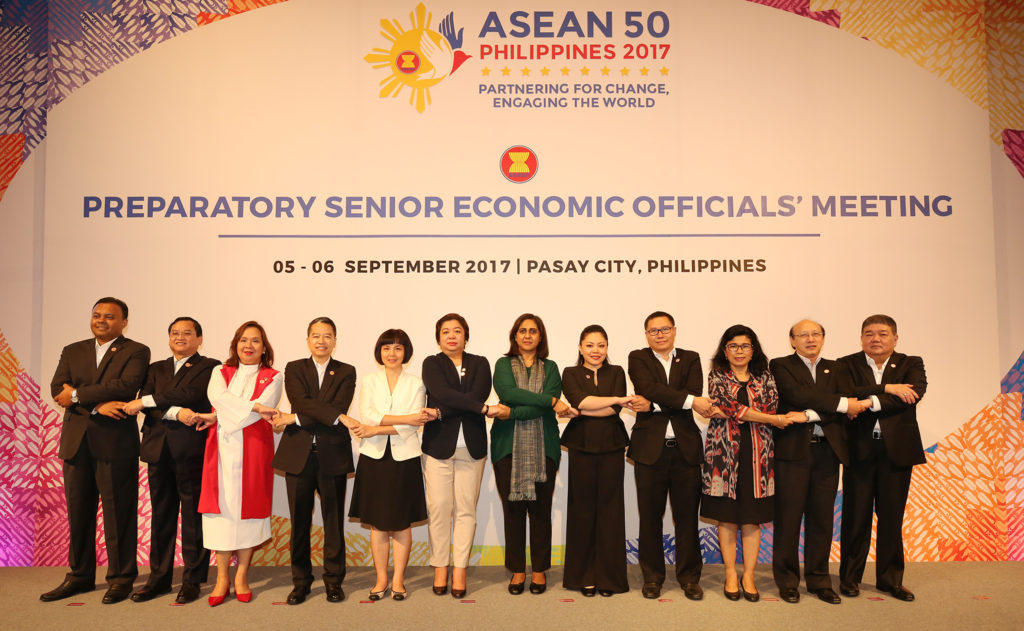
PREPARATORY MEETING FOR THE ASEAN ECONOMIC MINISTERS’ MEETING COMMENCES. Senior trade officials from 10 ASEAN Members States (AMS) gathered for a two-day preparatory meeting (5-6 September 2017) to refine points of discussion and agenda items that will feed into the 49th ASEAN Economic Ministers’ (AEM) Meeting and Related Meetings to be held on 7-11 September 2017, hosted by the Philippines, as chair of ASEAN 2017. The AEM meetings will focus on the strategic measures to pursue an “inclusive and innovation-led growth” thru increasing trade and investment, integrating the micro, small and medium enterprises (MSMEs) in the global value chains, and developing an innovation-driven economy. (From Left to Right) Malaysia – Ministry of International Trade and Industry Deputy Secretary General Datuk Isham Ishak, Myanmar – Ministry of Planning and Finance Director General Tun Tun Naing, Philippines – Department of Trade and Industry Bureau of International Trade Relations Director Ann Claire Cabochan, Thailand – Ministry of Commerce Department of Trade Negotiations Director General Boonyarit Kalanamit, Viet Nam – Ministry of Industry and Trade Deputy Director General Nguyen Thi Quynh Nga, ASEAN Senior Economic Official Chair and Philippine Department of Trade and Industry Assistant Secretary Anna Maria Rosario Robeniol, Singapore – Ministry of Trade and Industry Director-ASEAN Division Alphana Roy, Brunei Darussalam – Ministry of Foreign Affairs and Trade Deputy Permanent Secretary Norashikin Johari, Cambodia – Ministry of Commerce Director General Sim Sokheng, Indonesia – Ministry of Trade Director of ASEAN Negotiations Donna Gultom, Lao PDR – Ministry of Industry and Commerce Director General Laohoua Cheuching, and ASEAN Secretariat Deputy Secretary General Hong Hin Lim.
by admin | Aug 30, 2017 | Local News / Bohol Balita
SINANDIGAN UBAY, August 30, 2017 (PIA) –Aiming to sustainably replenish the stocks of swimming blue crabs (lambay) in Bohol, the government and a private sector group signed an agreement to formally establish a hatchery for the crustaceans popularly imported for their meat here at the local Multi Species Hatchery.
The government through the Bureau of Fisheries and Aquatic Resources (BFAR) regional Director Dr. Allan L. Poquita and Robert G. Eduardo chairman of the Philippine Association of Crab Processors Inc. ( PACPI) formally signed the agreement to mutually cooperate in the production of blue swimming crab August 30, here at the Multi species hatchery right in the middle of Danajon Double Barrier Reef.
Dr. Poquita said the historic event marks the rebirth of the blue crab meat industry through sustaining stocks in the region severely depleted by over harvesting in the past.
He said the project is consistent with BFAR mandate to promote the replenishment and propagation of crabs and achieve food security.
Here, the project intends to acquire suitable berried female crabs from fishers, but them at premium prices and bring them to the hatchery for spawning, according to Chairman Eduardo.
The ultimate goal is to be able to produce at least 20,000 to 30,000 hatchlings every month which would be dispersed to BFAR identified areas along the beneficiary towns and islands along the Danajon Bank, Dir Poquita added.
One of the projects goal is to enhance the Spawning Potential Ratio for blue crabs to a sustainable levels of at least 30%, according to PACPI Executive Director Josette Emlen Genio.
This means that of a female crabs average of 80,000 eggs, only 27% survive and mature enough to spawn, Genio cites recent blue crab studies by BFAR, PACFI and ECOFish.
Common at the Danajon and elsewhere in the Visayas, swimming blue crab (portunus pelagicus) is the country’s 4th in production volume for fishery commodity and 3rd in value production, BFAR emphasized.
However, swimming blue crabs which fetch a P180 to 200 a kilo in wet markets need to go past a gauntlet of obstacles including predation, undersized harvesting and a local culture running counter to sustainable harvest practices to make it past reproduction age.
Visayans prefer to harvest and eat berried or gravid crabs; the eggs indicate good meat.
The Memorandum of Agreement allows BFAR to allocate space, equipment and facilities for lambay production, advance mechanisms to curb the harvest of undersized and egg-bearing females, provide technical supervision in the hatchery production, identify future dispersal activities and monitor stocks, documenting the entire production progress process.
The agreement also makes PACPI provide technical and non technical staff and honorarium who will partner with the hatchery manager, give financial support to the project operation including acquisition of broodstock, feeds, fertilizers for natural food culture and facilities maintenance, provide additional equipment and supplies if needed and help BRAF document the processes.
For the one year project duration, PACPI dedicates P742,200.00 for the operation expenses and wages plus additional supplies and equipment if needed and a separate budget of P354,200.oo for post project assessment to determine the impacts of the hatchery reared-crablets to the wild stocks. (rahc/PIA-7/Bohol)
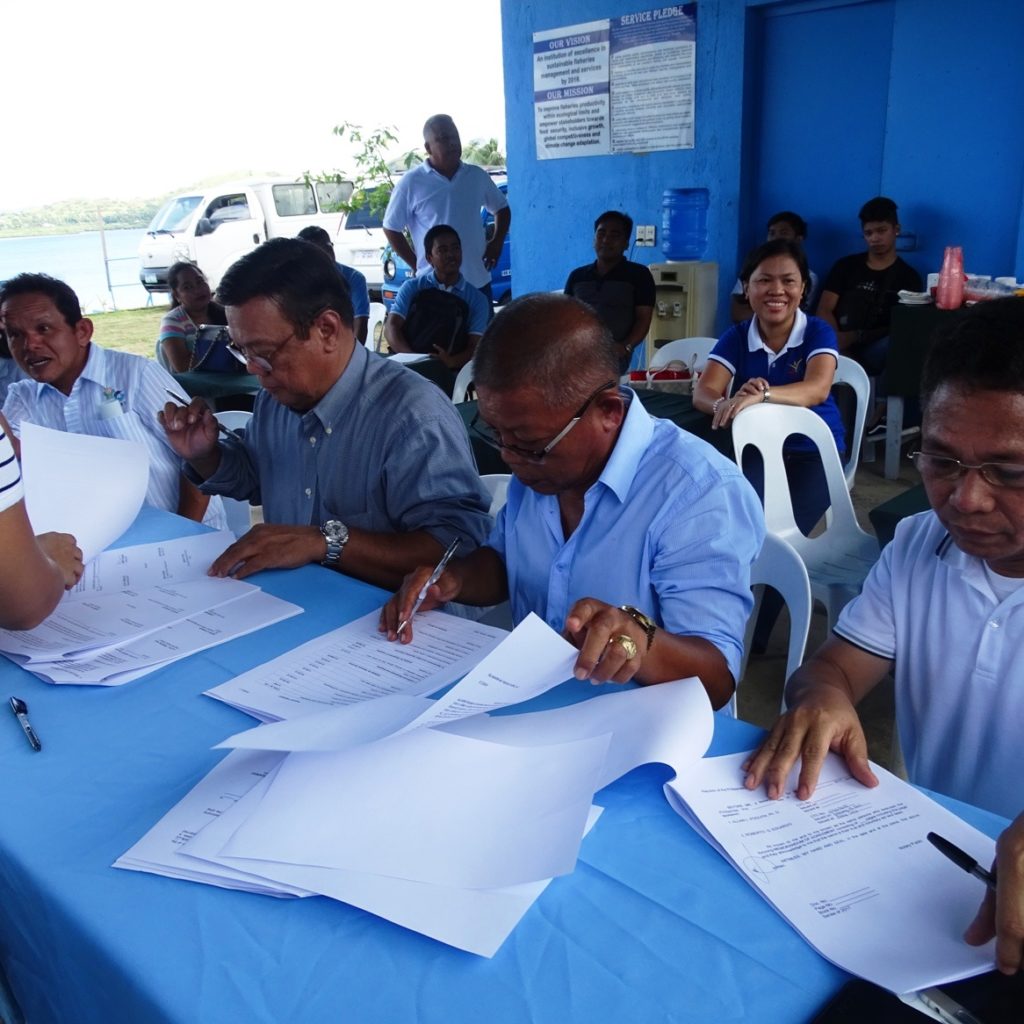
PACPI Chairman Robert G. Eduardo and BFAR 7 Regional Director Allan L. Poquita along with Sinandigan Ubay BFAR Multi-Species Hatchery Chief Conrado Toston sign the MOA formally establishing the blue swimming crab hatchery here. (rahc/PI-7/Bohol)
by admin | Aug 25, 2017 | Bird Flu News, DOH Updates, Headlines
TAGBILARAN CITY, August 25, 2017 (PIA) –There is another strong reason why hunting wildlife as defined by the Conservation and Protection of Wildlife Resources and their Habitats Act is bad.
The onset of an avian influenza (bird flu) outbreak in Pampanga and in Jaen in Nueva Ecija makes it possible for migratory birds on a pit stop in the Candaba marshes of Pampanga can be potential carriers of the deadly virus that can mutate and affect humans, health professionals said.
Wildlife conservationists see Candaba as an important staging and wintering site of migratory birds, it being part of the East Asia Pacific Migratory Flyway.
Candaba, a popular nesting, wintering and feeding site for birds escaping from the harsh winters in the north, is also home to local birds and ducks, well within the outbreak affected sites.
As the Department of Environment and Natural Resources (DENR) totally protects 47 of these sites, 23 sites are partially protected and another 47 sites are not protected, according to the government environment agency.
Over that, several areas in Bohol which hosts migrating birds, ducks and mallards are not in the list of DENR protection.
As these migrating birds including teals make their stops in 117 more important bird sites in country while carrying the virus, in Bohol, some of these stop by Malinao Dam in Pilar and mingle with the native wild ducks and mallards, possibly passing on the virus, warned Bohol provincial veterinarian (Pvet) Dr. Stella Marie Lapiz.
Wild duck and wild birds hunting hobbyists remain to be a top concern for veterinarians, because according to Dr. Lapiz, getting exposed to these infected birds and their body fluids is dangerous.
Although avian flu viruses do not normally infect humans, sporadic human infections with avian flu viruses have occurred, Center for Disease Control and Prevention continues to warn.
Birds sharing food, water and roosting spots could pass the disease to each other and to people who come in contact with them, according to the Department of Agriculture (DA) and the Bureau of Animal Industry (BAI).
In fact, in the outbreak, DA-BAI has asked people to get involved in monitoring the spread of the virus.
Communities can help by reporting illegal transport of infected products and monitoring areas where migratory birds can be stopping and mingling with native flocks.
According to DA BAI, for animal movement concerns, people can report to 09189171407 while for potential disease cases reporting, BAI suggests informing 09208543119 (Smart) or 09951329339 (Globe).
The DA has suspended the transport of fowls and products from Luzon to other parts of the country, following a transport ban issued a week ago.
The lifting of the ban however does not include products from the affected areas.
In Bohol, the PVet has implemented quarantine checkpoints to buses and boats from Luzon.
Footbaths, chemical spraying of vehicle tires and inspections of animal transport permits, veterinary certificates have been implemented, according to Bohol veterinary quarantine officer Maria Eleonor Abisado.
This as the government continues to issue warnings against eating raw poultry meat or eggs and thoroughly cooking them, to make sure the disease contamination is stopped.
Bird flu virus dies at 70 degrees and its exposure to the sun kills it, Dr. Lapiz added.
At this, she also reminded people: never get in contact with migratory, wild or resident birds, do not release of expose birds to the wilds and wash hands thoroughly with soap and water after accidental exposure to birds and fowl. (rahc/PIA-7/Bohol)

DENR’s Cora Colarines explains during the Kapihan sa PIA the country’s wetlands and the migration of birds from the north. Migratory birds stopping by Candaba in pampanga could pick up the bird flu virus and carry it to Bohol, she warned. (PIABohol)
by admin | Aug 12, 2017 | Headlines, Local News / Bohol Balita, Tech Talk
PANGLAO, Bohol, August 7 (PIA) –Clean energy revolution in small amperage light rolls off from here and it is a wolf in sheep’s cloak.
An ordinary dirty energy kerosene lantern which otherwise would have given a warm flickering incandescent glow now gets a new light source: clean Light Emitting Diode (LED) powered by solar energy.
“Thanks to Liter of Light and MyShelter Foundation who taught us how to do it,” confesses Jane Heberly Bompat, Grade VI pupil at Lourdes Elementary School (LES) in Panglao.
Assembled by LES kids, the repackaged lantern would soon be among the innovations the Liter of Light and its 34 Bohol children ambassadors would be using to spread light into the country’s communities still darkened by energy poverty.
“How could we help 20 million Filipinos without access to light? Do we give them light from patented sources which is expensive and hard to repair or do we think of innovations?” asked Liter of Light and MyShelter founder Ilac Diaz.
Asked how his mission came about, Diaz was more willing to share.
It all started with one bottle, one carpenter, one inspiration and an empty liter bottle of soda.
Diaz said they had to come up with a solution in providing light to help communities wiped out by Haiyan, and Filipino bayanihan was a good concept to start with.
Liter of Light filled the PET bottle with water and bleach and stuck it in house roofs to produce refracted illumination indoors.
But for Haiyan victims, “buying was an option but shipping cost would eat up about 70% of our budget, we need to come up with something unique not top down imported, patented and expensive , but bottom up and local so it can be fixed,” Diaz added.
“Why import when we could just overhaul what is there?” he pointed out citing the kerosene lamps which were given to communities after the disaster.
In these areas too, kerosene lamps caused other problems: they burned children and women and houses, he noted.
“In kerosene lamps, we thought of converting it to solar powered lamps using LED,” Diaz who presided over a workshop at the Asian Cooperation Dialog (ACD) in Panglao intoned.
“We want local materials, done by local skills and fixible so the community can build and rebuild or fix it again as we go,” he excitedly narrated his soon-to-be mainstreamed clean energy.
Operating on empowering people to do more to uplift them instead of doling out, Liter of Light saw that transforming a dirty energy into sun power is most sustainable.
“The country has this south-south orientation which provides us maximum exposure to the sun,” he commented on why solar of all low cost and renewable energy sources.
The lanterns they asked children to build is 1 ampere LED mounted on a printed circuit board and getting solar energy packed in a battery inserted inside the lamp.
At the ACD, 34 children: 17 boys and 17 girls patiently showed to the representatives of the 34 country energy bloc how to build and rebuild the solar lanterns.
The ACD gathered Asian energy leaders and think-tanks to share and exchange expertise and ideas about making energy sustainable and affordable to energy deprived areas.
This is transforming a dirty energy to a clean energy solution and the government is keen in its support because solar energy is the right energy because it preserves our resources, Diaz summed. (rahc/PIA7/Bohol)
Carabao dairy: Bohol farmers
option for additional income
TAGBILARAN CITY, August 11 (PIA)–Then thought of only as a farm animal and meat source, the Philippine water buffalo now proves is also a source of extra income in high quality milk and cheese, says experts at the Philippine Carabao Center (PCC).
A potential source of additional income for farm families who have to sideline farm work to allow a birthing carabao the respite to nurture the young, carabao milk has been proven to be a good income source, according to PCC veterinarian Dr. Gondolino Bahinting.
To highlight on the viability of carabao as milk source, the PCC at the Ubay Stock Farm (USF) says other than giving off a calf, a mother carabao can also be a good source of high protein, low cholesterol, mineral and calcium rich milk that could be suitable for mozzarella.
Compared to other milk, a 200 milliliter glass of carabao milk contains about 9 grams of heat resistant protein.
“Because it doesnt break down easilly, the body tends to get more from it,” explains a dietician when asked about heat resistant proteins.
And carabao milk contains low cholesterol and is ideal milk for persons with diabetes, dyslipidermia, hypertension, kidney diseases, polycystic ovarian disease and obesity, PCC claimed.
Known to have high fat percentage and is thicker than other kinds of milk, the heavy carabao milk has been identified as good for healthy weight gain and is excellent for cheese and ice cream making, says PCC information officer Leniefe Libres.
In Bohol schools now, carabao milk supplemental feeding program supports the province’s goals of wiping malnutrition.
Besides, carabao milk is extremely rich in calcium and is a great source of minerals like potassium, magnessium and phosphorus which is great for building bone and bofy strength, Libres added to highlight its nutritional prowess.
“Experiments showed that carabao milk has very good stretching and melting characteristics that make it ideal for mozzarella,” PCC claimed.
“The native carabao however could only produce about 6 liters in two milking sessions a day compared to 12 liters from foreign breeds, but with a calf to add to the profit, it should be just okay,” a PCC carabao loan porgram beneficiary posed in comparison.
A farmer with a milking carabao however has to wean the calf early and induce the milking to harvest enough to feed the calf and process more milk.
With the provision of carabao milk as alternative, the PCC nears in its mission to make available locally produced affordable and high quality fresh dairy products while uplifting the socioeconomic status of dairy farmers as well ad improve nutrition and lives of Boholanos.
Along this line, the PCC has been tending a carabao ranch, a milking shed and has produced 200 liters of milk a day to prove milking can be viable for farmers.
“We do not do this for profit. We are doing this for farmers to imbibe as livelihood,” Dr. Bahinting claimed as he explained to tourists at the PCC farm tour.
From its processed milk, PCC and its supervised Bohol Dairy Cooperative makes pasteurized fresh milk, chocomilk, mango flavored milk, yoghurt, banana loaves, milk cakes, torta, pastillas de leche, vinegar-based white cheese, caramilk ice cream and its nutri packaged milk bars. (rahc/PIA7/Bohol)
Good health keeps
body off from “TB”TAGBILARAN CITY, Bohol, August 12 (PIA)–Always get a good rest, eat the right food and exercise, that in itself can be a great defense against tuberculosis.
A nurse at the Provincial Health Office and the Provincial Coordinator for the National Tuberculosis Program (NTP) dished out this advice amidst the reality that there are still a good number of undetected cases of microbacterium tuberculosis (TB) in Bohol.
While the PHO noted a high curing rate for people treated with TB, the case detection rate in Bohol is still a low 62%, Rances reported at Kapihan sa PIA for Lung Month in August.
The NTP pegs a target of 90% TB case detection rate but PHO cited problems with finding these people afflicted with the contagious bacteria.
Communities are supposed to help us seek these people who may have cough for the past three weeks, have unintentionally lost weight, has fevers, chest and back pains, said PHO nurse and NTP Bohol coordinator Polizena Rances.
Once reported, these people vould undergo confirmatory tests through gathering of sputum samples and when found positive, be placed under the free Directly Observed Treatment System for TB (TB DOTS).
Unreported, these people put their family members at high risk of infection, Rances added.
TB bacteria is spread with the air as the TB positive coughs or sneezes and the air is inhaled.
Although most healthy people have antibodies that naturally fight off the infection, those with low immunity tend to contract the disease.
About 95% of healthy people with strong resistance can self-cure TB, Rances revealed.
In fact she added that the usual habit of detaining patients in a closed room exacerbates the possibility of infection.
You close the room, you contain the bacteria which can degrade when exposed to sun and thins into insignificant numbers in open air, she explained.
In addition, as soon as the patient has been placed under TB treatment regimen, the possibility of him spreading the bacteria stops.
She however cautions.
A patient ho has started medication has to religiously obey the fixed dose or he could develop a Multi Drug Resistant TB, a much tougher bacteria to beat, PHO said. (rahc/PIA7/Bohol)
DoE works for “LNG”
powerbarge to BoholTAGBILARAN CITY, August 9 (PIA)–Consistent with Bohols green development agenda, the Department of Energy (DOE) unwittingly leaked its plan to bring to Bohol a cleaner source of power in a barge.
During a press conference at the BE Grand Hotel in Panglao, no less than DOE Secretary Alfonso G. Cusi timidly confirmed the plan after a slip of the tongue when he exposed the plan to send in a liquified natural gas (LNG) floating power plant to Bohol.
The press conference of the First East Asia Energy Forum which also had Japanese professor president of the Economic Research Institute for ASEAN and East Asia Hidetoshi Nishimura, Shigeru Kimura of ERIA, Energy Research Institute Network Chair and associate professor Romeo Pacudan, Sec. Alfonso G. Cusi tackled the directions East Asia and the Philippines is taking in its energy development in response to the pressing industrialization needs of the times.
While the DOE admitted its direction towards an establishment of an energy source that is attainable in the shortest term to keep up to the countrys development pace, the Philippine direction towards clean coal became apparent.
“The Philippine direction is building up more coal fired plants, which should comprise 50% of the 80% energy supplied by conventional energy,” he said.
The rest of the 20% should be from renewables.
The downside for renewables however is that these are dependent on the times.
When the sun is out for example, less energy is gathered or hydropower is dependent on the water supply, energy sources said.
The move for coal considers that the Philippines has coal while it is also available from Indonesia, Australia and Russia, its import price affected by economics of supply and demand, Sec. Cusi who led the host nation in the Asian Cooperation Dialog in Panglao.
As to the environmental concerns of coal, the energy bigwig was quick to the follow-through: 50% is from green-coal technology, he stressed.
“Technology has done great lengths to reduce coal carbon emissions,” the secretary said even as he assured that the government is also looking at socio economic as well as the ecological impacts of coal.
But with Malampaya in the Philippines producing natural gas, the DOE is eyeing these as source of back up power for Bohol.
This is also considering that the only time Bohol could have a redundant power supply system is when the National Grid Corporation of the Philippines completes its Cebu-Bohol interconnection by 2020.
An earthquake that shut down the geothermal plants in Leyte last July disrupted Bohols power supply blanketing the island in darkness for a few nights.
A few landbased plants later supplied 20 megawatts of the 69 megawatts the entire island needed.
Weeks later, NGCP tapped Bohol to the Cebu-Negros-Panay grid which supplied some of its power requirements.
Bohol officials who have yet to accept bids for more landbased power, has arranged for a diesel power barge to complement the supply, but none has arrived yet.
The DOE did not also say when the clean barge is coming and from where would this come from. (rahc/PIA7/Bohol)
by admin | Jul 30, 2017 | Local News / Bohol Balita
By JUNE S. BLANCO
REP. Erico Aristotle Aumentado of Bohol’s 2nd District is bullish on producing energy from residual waste.
He met last week with a waste-to-energy expert to discuss where and how his constituency can participate.
Aumentado said waste-to-energy calls for the segregation of waste. Biodegradable waste can be fodder for biomass energy, or at least, can be turned into organic fertilizer. But, the solon quoted the expert, residuals can be turned into energy as well.
This, the solon said, is where his constituents can be motivated to better implemented Republic Act No. 9003 or the Ecological Solid Waste Management (ESWM) Act.
Waste-to-energy is a two-pronged approach to contribute to mitigating climate change, he explained.
On top of pushing for zero waste at the household level, turning residuals to power means less bulk for landfills, savings in tipping fees and contribution to the longer lifespans of sanitary landfills.
The solon noted that once landfills are filled to capacity, a local government unit (LGU) operating it must look for another site to contain residual waste. Bohol may be the country’s tenth largest island, but it does not have the luxury of space.
Aumentado said Bohol is basically agricultural and ecological. In order to feed the people, landfills and space-intensive solar panels must not compete for space with agricultural lands and the imperative forest cover. After all, he said, agriculture and tourism are the province’s economic drivers.
Power generated from residuals, the solon said, will also be the 2nd District’s contribution to locally-generated energy.
Aumentado pointed out that only the power industry approves of, and even requires redundancy. This is so that business will not come to a standstill when one source experiences breakdowns like what happened to the Tongonan Geothermal Power Plant in Leyte following the recent 6.5 earthquake and before that, Typhoon Yolanda in 2013.
Leyte is Bohol’s main power source. Unless the latter produces more locally-generated power, it will always endure long rotational blackouts, he explained.
The downside to this is the slowing down of business, especially tourism, due to higher overhead costs in operation. After all, in most cases, water distribution is also dependent on power.
Aumentado has broached the topic to the 2nd District mayors in one of their meetings at the Quest Hotel in Cebu City. He said the mayors have committed their support to the waste-to-energy project by more stringent implementation of RA 9003.

