by admin | May 25, 2018 | Business, National News
ERIKA MARIEL GINES

BIZCON. Pampanga Chamber of Commerce and Industry, Inc. and Philippine Chamber of Commerce and Industry executives join former president and Pampanga second district Representative Gloria Macapagal-Arroyo for a photo opportunity, after her keynote speech at the 27th North Luzon Area Business Conference held at the LausGroup Event Center. (Erika Mariel Gines Photo)
“This area business conference is a testament that indeed, Central Luzon and the province of Pampanga in general, is becoming the center of growth not only in the region but of the whole country.”
This was the statement of Pampanga Chamber of Commerce and Industry, Inc. (PamCham) vice chairman Rene Romero during the culminating ceremony of the 27th North Luzon Area Business Conference (NLABC) held Friday, May 18, at the LausGroup Event Center in the City of San Fernando.
He noted that the three-day event proved to be “one of the most successful” area business conference of the Philippine Chamber of Commerce and Industry (PCCI), as it gathered over 600 delegates coming from all over North Luzon.
“We are really very happy with the outcome of our event, as modesty aside, while it is our first time hosting this conference, we have come up with the biggest and most organized NLABC I have seen for the last 30 years that I have been part of the chamber movement,” he relayed.
He added that the positive feedback of the participants proved that event was able to showcase the latest developments in Pampanga which include state-of-the-art facilities, infrastructure, and the province’s renowned hospitality sector, further centering the province’s status as a major economic destination.
“In fact, delegates coming Ilocos Region, Cagayan Valley and Cordillera Administrative Region (CAR), all expressed their awe upon seeing our province’s progress. They said they were impressed of Pampanga’s recent developments including the LausGroup Event Center, our main roads like the Jose Abad Santos Avenue and the McArthur Highway, business districts, the Clark Freeport Zone, and even the hotels and malls including the newly-opened SM City Telabastagan,” he shared.
“This goes to show that we are now experiencing the spill over of Metro Manila and big players are now eyeing us as their next prospect. The NLABC is one of our way of preparing for this forthcoming economic boom,” he added.
The executive then relayed that the business organization will continue to hold on to the claim that “This is our time,” this year’s theme for the 27th NLABC.
“This is just the start, and for a very long time and through the generations to come, we will not stop or plateau. It will be a continuous process,” he concluded.
The prestigious business conference, organized annually by PCCI, aimed to inform, inspire, and motivate businesses to spur countryside economic growth in Central and North Luzon regions.
This year, highlights of the event include plenary sessions led by world-renowned businessman and AirAsia Group CEO Tony Fernandes, top Filipino economist Dr. Bernie M. Villegas, and Department of Public Works and Highways Undersecretary for Planning and Public-Private Partnership (PPP) Dr. Maria Catalina E. Cabral, among others.
The event was keynoted by former President and Second District Representative Gloria Macapagal-Arroyo who shared the government’s plans and activities currently in the pipeline for the years ahead, demonstrating a strong focus on transforming the province as a ‘Megalopolis’.
Also part of the programs and activities were various seminars, business matchings, networking sessions, invitational golf tournament, and a mini regional trade fair.
Read more: http://www.sunstar.com.ph/article/1744035/Pampanga/Local-News/Business-conference-showcases-Central-Luzon-Pampangas-progress
by admin | Feb 11, 2018 | Headlines, Kita ug ang Gobernador
TAGBILARAN CITY, February 6 (PIA)–The Department of Agriculture (DA) is funding the construction and operation of a genetic molecular laboratory here in Bohol, at the Ubay Stock Farm (USF) in Ubay town.
Agriculture secretary Emmanuel Piñol revealed this as he explained the new direction in the country’s livestock dispersal program during this term, during his first official visit to Bohol January 26.
Speaking before a gathering of dairy industry stakeholder members of the Bohol Dairy Producers Association (BODPA), the Cebuano speaking secretary explained that the molecular laboratory is a long overdue support for the region’s livestock industry.
The molecular laboratory is a research and development facility which will be the center of a wide variety of scientific research in multiple disciplines in cattle and carabao breeding and genetics, biotechnology, nutrition and forage or pasture, animal health, reproductive physiology, management, product development as well as socio-economics and setting policy directions to the country’s livestock industry.
The DA, which is facilitating the entry into the country of some 5,000 heads of girolando cattle breeds here would largely be using artificial insemination (AI) and genetic engineering to make sure the succeeding calves bred would retain if not enhance the local dairy production as envisioned by the government as better breeds.
AI is basically a reproductive tool which harnesses the potential of outstanding males or sires.
Girolando, according to Pinol is a Brazilian accidental bred when a Holcein jumped off the coral and bred with a Gir, which produced a girolando offspring that increased the breed’s capacity to milk, several times.
Now the record keeper for the world’s most milk harvest at 105 liters in a day, the girolando which are now in quarantine prior to its shipping to Bohol would need the scientific laboratory to keep its milk production capacity at its peak, Pinol said.
The other goal is to make Bohol the country’s leading supplier of girolando breeds, Sec. Piñol revealed, even as he explained that cattle can only give milk if they give birth to calves.
Planned for reproduction using the trusted artificial insemination, the molecular laboratory can largely help in enhancing breeds and engineer them to best suit the tropical climate, taking specific characteristics from other milking breeds and increase production.
Moreover, the molecular laboratory operates as a research station where communal farming adopting communities can consult on issues of the animal health through diagnostic services and other support services.
And then revealing the current administration’s directions into animal dispersal, Piñol said he is now more keen on communal dispersal programs instead of the individual dispersal program.
During the individual dispersal regimes, a poor farmer who is given the chance to have a say to the dispersed farm animal would always sell the animal he can’t feed anymore if he can’t feed his family.
That is why, when it’s tuition fee times, more government dispersed animals are reported as they fell of ditches, died or were sick they have to be slaughtered, he poignantly illustrated those in the poverty bind.
As the DA intends to bring to Bohol 5,000 dairy cattle to support the country’s dairy supply and give it a boost, the calves would be put in dispersal programs for the cooperatives instead, where many people can have a say to an animal.
DA wants cooperatives to be dispersed with at least 240 calves which they would feed and fatten and when matured, would milk on their own ad earn.
The system too allows the province to graduate from importer of the Girolando to be a top exporter of the world’s top milking cow bred to farmers all over the whole country. (rahc/PIA-7/Bohol)
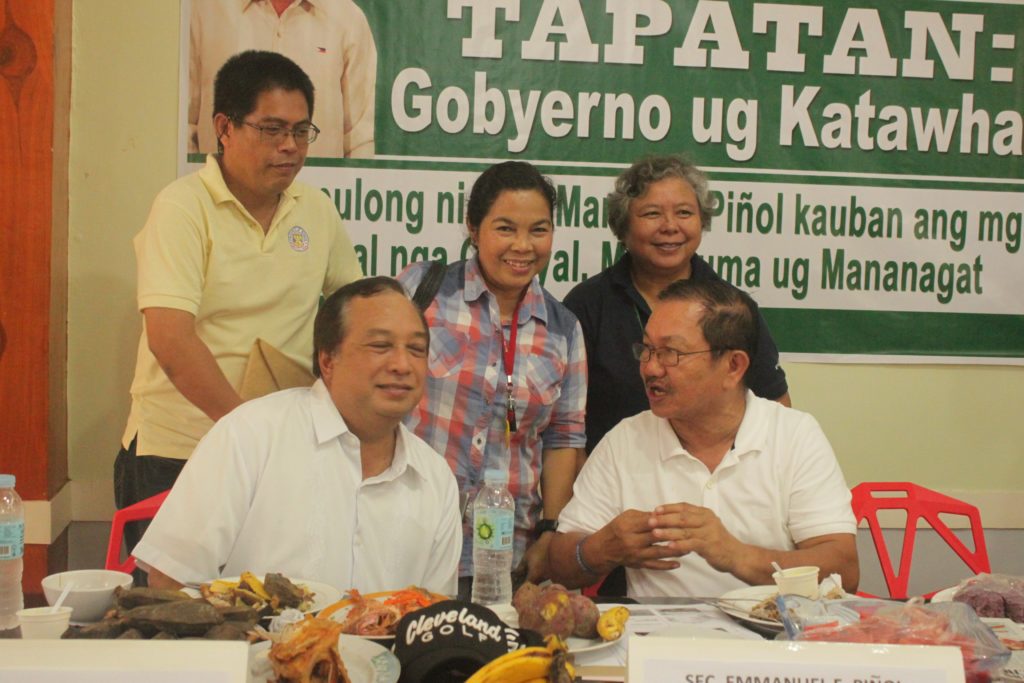
DA Secretary Emmanuel Piñol reveals the government move to set up a molecular laboratory in Bohol as a long overdue support to livestock here. He said the laboratory would be a crucial hub for the reproduction of the girolando cattle, which has to bear calves to milk. With the secretary are Gov Edgar Chatto and the Provincial Veterinary officials led by Dr. Stella Marie Lapiz. (rahc/PIA-7/Bohol)
by admin | Nov 7, 2017 | National News, Photo Story
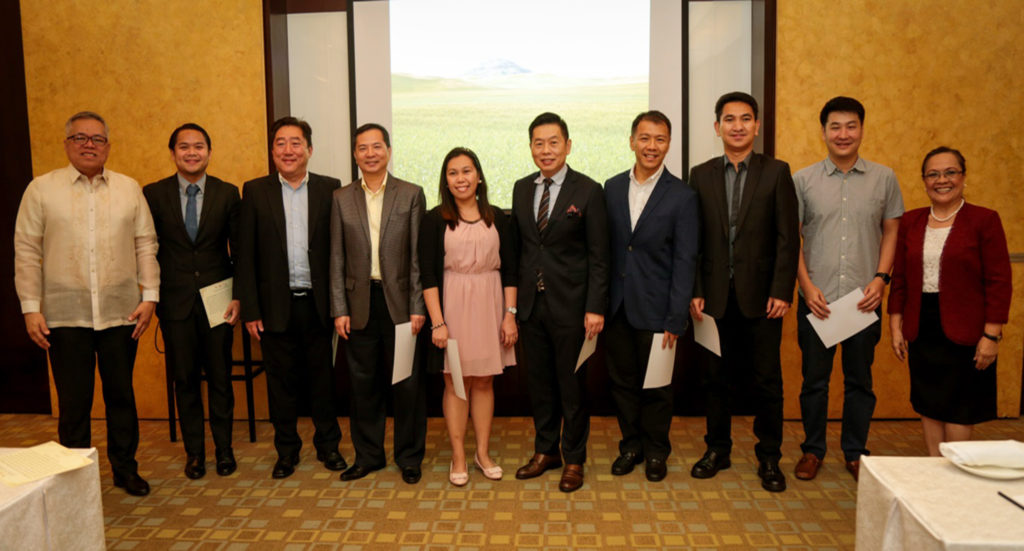
SEC. LOPEZ SWAYS PHILBAKING TO AID MARAWI RESTORATION. Trade Secretary Ramon Lopez (leftmost) recently (23, October) met with the Philippine Baking Industry Group Inc. (Philbaking) to lead the induction ceremony of new officers in Makati. Trade Secretary Lopez urged baking industry players to take part of the restoration of the newly liberated Marawi City by exploring possible opportunities providing livelihood to the Internally Displaced People (IDPs) of Marawi. Members of the association, on the other has given positive feedback with the advocacy of the Trade Secretary, and promised to further look on possible areas of collaboration with the Department of Trade and Industry (DTI), helping the Maranao community rebuild again. Also in the picture (from L to R) were Philbaking President Paolo Victor Valderrama with other officers Jerry Lao, Walter Co, Gemenni Monton, Johnlu Koa and Edwin Cua, Jay Ferolino, Jon Chua and DTI Undersecretary Ms. Zenaida Cuison Maglaya
by admin | Oct 24, 2017 | National News
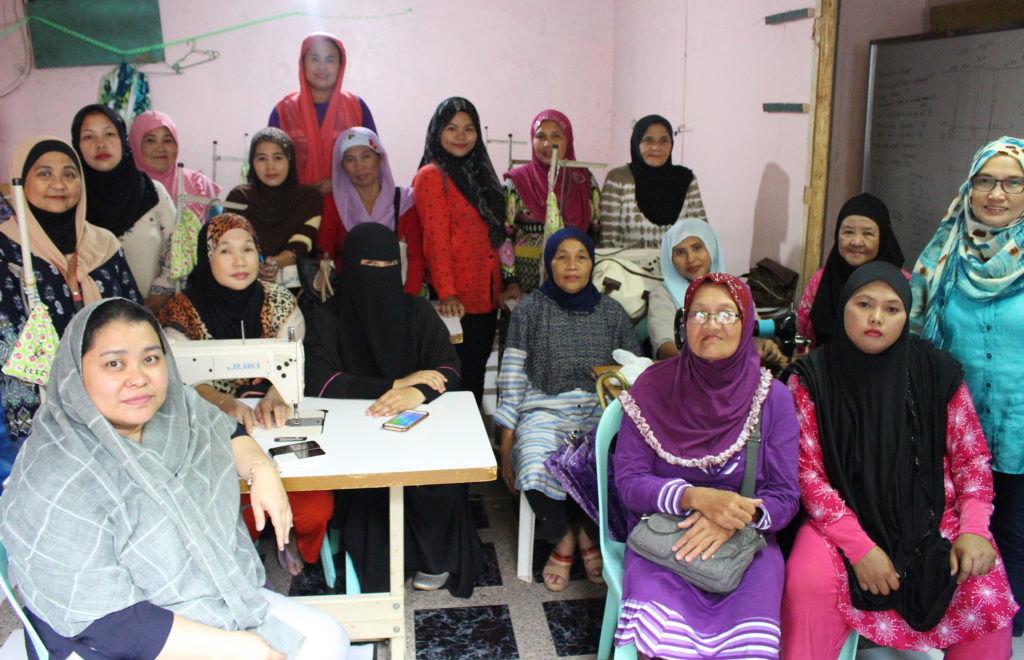
Making ends meet is a great challenge for residents of Marawi City but these women are doing everything just to stay afloat and keep their family alive.
Sewing was their regular source of livelihood, but all of a sudden, it came to an abrupt end. On May 23, 2017, thousands of families were displaced by the war and scores of families had to flee to ensure their families’ safety.
But as they say, there’s a light at the end of the tunnel.
To hasten the recovery and rehabilitation of Marawi City, the Department of Trade and Industry (DTI), which leads the Bangon Marawi Task Force Sub-committee on Business and Livelihood, provided these with sewing machines and cloth as starter kits to help them earn while staying either homebased or at evacuation centers.
Back in August, DTI-Region 10 identified 16 women internally displaced persons (IDPs) who will be trained for dressmaking and were awarded with the sewing kits. The 16 sewers are able to generate income for themselves.
From the Sta Elena Gymnasium, where they temporarily stay, the 16 women sewers go to the Provincial Training and Livelihood Development Center in Iligan City, where every sewer can earn at least P500 after a day’s work.
For Asnia Sandiman, 23, laying hands on a high-speed sewing machine was a dream come true. Even as a kid, Asnia has been sewing handwoven tube skirts or malong in Filipino, shoals, and long dresses to earn extra for her schooling and for her family.

But with the new sewing machines and cloth provided by DTI, Asnia can earn up to P1,300. At school, her classmates also ask her to sew for them, allowing her to earn even more.
To Asnia, the new sewing kits was her new lease on life amid the crisis that she and her family are going through.
“Naappreciate namin at sobrang masaya kami. Parang nabigyan kami ng panibagong buhay,” a teary-eyed Asnia said, while recalling the time when the terrorists where banging on their door.
“Malaking tulong sa amin ito,” she added.
On the other hand, the DTI’s Negosyo Center and PTLDC ensure that the handwoven malongs, shoals, and long dresses made by the IDP sewers go to the market. Indeed the products ended up in the right market with orders coming in from SM Cagayan de Oro, Manila, the Bangon Marawi Concert, Bangon Marawi Store at DTI main office in Makati City. There are also orders from Rustan’s for the Go Lokal! Project.
Fellow IDP and 36-year-old Memeng Dianal, said the sewing kits allowed her to feed her six children everyday. From P500 she earns before, now, Memeng earns P2,000 a day, finishing at least 20 handwoven malongs, shoals, and long dresses.
“Malaking tulong ito sa amin [sewing kits] kahit kaunti-konti natutustusan namin yung araw-araw na pangangailangan namin,” Memeng said.

Despite knowing that her family’s home in ground-zero is now levelled due to the conflict, Memeng is hopeful that once they return to Marawi, there will be more opportunities for her and other Marawi residents. If only she can handle two businesses, she would do it for her children.
“Kung pwedeng doblehin ang business, magdodoble kayod ako para sa mga anak ko,” she said.
Now with the fighting officially declared over by the government, Asnia and Memeng, together with other residents of Marawi will just have to wait for their return to their hometown.
After all, hope springs eternal.
by admin | Sep 15, 2017 | ASEAN agenda, Business
The Philippines launched the APEC MSME Marketplace, an online platform to promote trade and internationalization of micro, small, and medium enterprises (MSMEs), during the 24th APEC SME Ministerial Meeting held in Ho Chi Minh City, Viet Nam on 15 September 2017.
“The APEC MSME Marketplace aims to enable MSMEs to participate in meaningful global trade, and in the process harness their ingenuity, boost their competitiveness, and achieve prosperity and inclusive growth in the Asia-Pacific,” said Philippines Department of Trade and Industry (DTI) Secretary Ramon M. Lopez.
The online platform which is a cross-border business-to-business (B2B) platform is part of the Philippine commitment to implement the Iloilo Initiative: Growing Global MSMEs for Inclusive Development, which was earlier adopted by the APEC SME Ministers in 2015. It seeks to provide bigger voice and better opportunities for APEC MSMEs.
Accessible via www.apecmsmemarketplace.com, the APEC MSME Marketplace which will showcase products and sellers, and trade facilitation services, is the result of the collective efforts of the 21 APEC member economies to contribute to the shared vision of mainstreaming the MSMEs into the global economy.
Lopez added that growth can only be meaningful if it is inclusive and sustainable and this is a priority objective under the Duterte administration.
“This is also the enduring vision of the APEC MSME Marketplace, its reason for existence,” he said.
The portal aims to: (1) facilitate business networking and matching involving MSMEs and large enterprises; (2) enhance MSMEs awareness on trade regulations and encourage participation in policy development; and (3) improve knowledge sharing and capacity building for MSMEs.
To engage the MSME sector to help build sustainable and inclusive growth in the region, the APEC MSME Marketplace is being implemented in three phases.
On its first phase (2016-2017), the Marketplace created linkages to key information by member economies and other available resources, particularly on trade regulations and business support services. In its current phase (2017-2018), more site functionalities are being developed. This includes, among others, the provision for MSMEs to join the directory of exporters.
For the third phase (2018-2019), APEC is working on increasing the trade facilitation capability of the Marketplace through more business matching activities.
Users and stakeholders are encouraged to provide feedback to help improve the site as the region’s trading environment continues to evolve.
Through the Marketplace, MSMEs are well placed to leverage on the endless and exciting opportunities to go global and penetrate more markets.
“The challenge now is to continue to take the innovation and trade agenda forward by leveraging on strategic partnerships that will enable MSMEs to gain the most benefit,” Lopez added.
He called on all APEC member economies to work for closer cooperation and stronger collaboration as they work toward fulfilling their commitment to MSMEs: to help them become competitive and resilient as they embrace the opportunities and challenges globalization brings

