by admin | Sep 9, 2015 | Headlines, Local News / Bohol Balita

For whatever reasons, CFO might not accurately pinpoint but when Pilar, Sierra Bullones make it among the Bohol towns with most au pair, influencing friends and neighbors to go abroad might be a good reason why many Boholanos are tagged in the CFO service. (rac/PIA-7/Bohol)
TAGBILARAN CITY, Sept 7 (PIA)–Believe it or not, three towns in Bohol have been tagged by the Commission of Filipinos Overseas (CFO) as having the highest number of “au pair” beneficiaries.
And what is that “au pair”? It is French for, “at par” or equal, and allows a young person to partially work as domestic assistant in a foreign country by taking a share in the host family’s responsibilities, while the other part, is for the person to get to school.
And while au pair has presented to Filipinos a way to study, in exchange for childcare, some light housework, Boholanos from Pilar, Sierra Bullones and Tagbilaran have been most numerous in the CFO list.
Au pairs work but while working light jobs, they take on easy tasks because government regulations allow them to be in the foreign country primarily for reasons of education, said Princess Mayumi Kaye Peralta of the CFO project management division.
So when the name doesn’t ring a bell, it may be because the program, which has been on since 2000, was temporarily suspended owing to the tendency of host families to abuse the good-natured Filipinos, the CFO administrative assistant said.
Then, au pairs who stay in the host families, when they do the laundry, initially offers to include a few until the government realized the candidate was washing all the laundry and has few hours left for studies.
An au pair receives an allowance, and a private room, the usual practice is that au pairs eat with the family most of the time, and join in some of the usual family activities such as outings and trips.
However, host families normally expect to have some private time to themselves, particularly in the evenings, that during this time, au pairs may retire to her room to study, or go out with friends.
To protect their rights, governments impose limits as to how many hours an au pair is allowed to work. Tasks can include taking children to and from school, taking children to after-school activities, cooking, cleaning, ironing, tidying up and babysitting. Each placement varies depending on the host family.
The key operative word is “limited household services”, adds Arthur Joseph Vitasa, emigrant services officer at the CFO.
So, while doing child care to the host family, a Filipino student can study and take on two-year courses, when he is petitioned by the host family to be domestic assistant.
Au pair schemes are subject to government restrictions which specify an age range usually from mid-late teens to mid to late twenties; some countries explicitly limit the scheme to females, according to sources separate from the CFO. (rac/PIA-7Bohol)
by admin | Sep 5, 2015 | Headlines
The Department of Trade and Industry Bohol Provincial Office opens its second Negosyo Center at the Capitol Building on September 4, 2015. The opening program was held at the Governor’s mansion shortly after the blessing ceremony. Bohol Governor Edgar Chatto, Tagbilaran City Mayor John Geesnell “Baba” Yap, DTI Bohol Provincial Director Nanette Arbon, DTI 7 Regional Director Aster Caberte and Bohol Investment Promotions Center Chief Inday Dominise were present as well as officers from the Bohol Chamber of Commerce and Industry and various local officials.
Senator Paolo Benigno “Bam” Aquino, co-author of the senate bill legislating the opening of Negosyo Centers throughout the country, was the guest speaker of the program. Earlier in the morning, the senator met with the board of trustees of the Bohol Chamber of Commerce and Industry at the Coralandia Resort for a meeting discussing the enabling environment for SMEs.
The Negosyo Center will become a venue for both existing and new businesses in Bohol to collaborate, share information, explore partnerships and negotiate. The center is mandated by RA #10644 or the Go Negosyo Act to make it easier for Filipinos to register and start up their businesses, as well as gain access to sources of financing. DTI will also organize seminars or learning sessions open to all business owners at the center. Senator Aquino wishes that the center will become a “tambayan” for SMEs. He encouraged businesses to try to source out raw materials, services and products locally in order to have a significant economic impact to the community.
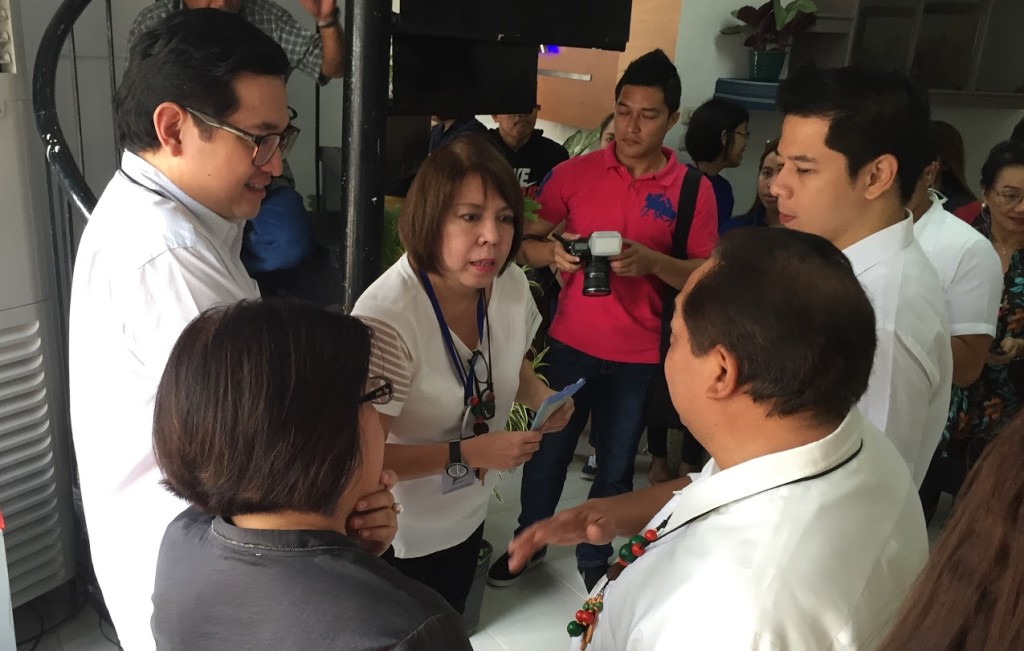
Sen. Paolo Benigno “Bam” Aquino, DTI-Bohol Provincial Director Nanette Arbon, Tagbilaran City Mayor John Geesnell “Baba” Yap, Bohol Governor Edgar Chatto and DTI-7 Regional Director Aster Caberte in a huddle after the blessing ceremony of the 2nd Negosyo Center in Bohol.
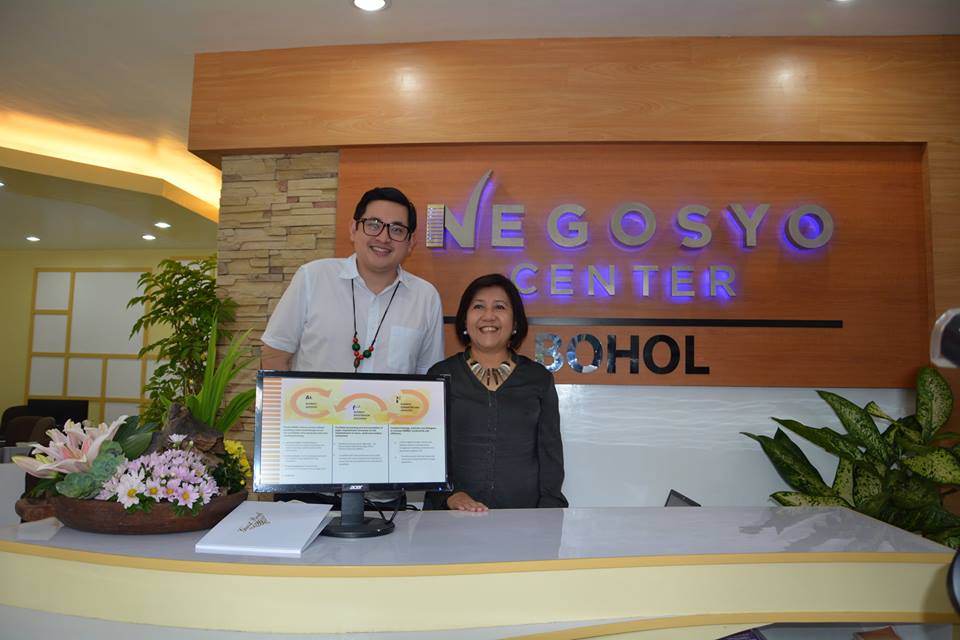
Sen. Paolo Benigno “Bam” Aquino (L) and DTI-7 Regional Director Aster Caberte at the newly opened Negosyo Center at the Capitol Building.
by admin | Aug 29, 2015 | Headlines, Major Events

It all redounds to traffic problems, sums up the PPOC who noted that a better traffic laws enforcement can drastically cut Bohol’s crime volume into half. Over this, police Colonel Dennis Agustin wishes local governments and executives can help them get the roads safer for everyone. (rac/PIA-7/Bohol)
TAGBILARAN CITY, Bohol, August 29, (PIA)—Although crimes in the count were only those happening in Bohol from the first to the third week, a difference of 285compared to the previous month, lead police statisticians to note that August had fewer crimes.
At the recent Provincial Peace and Order Council (PPOC) Meeting, Camp Dagohoy bared they tallied only 470 cases in August compared to 755 in July of this year.
In a report read by Camp Dagohoy Chief Police Senior Superintendent Dennis Agustin, the 470 cases in August comprised of 299 index and 171 non index crimes.
This, according to the police chief is much lower than the 444 index and 311 non index crimes in July, making up to the 755 crimes recorded during the month as reported during the August 5 PPOC meeting.
The same decrease in crimes is also clearly reflected in the 124 physical injury cases compared to the 216 cases during the previous month.
Crimes of theft also enjoyed significant decrease from 135 last month to 108 while robbery, which had 47 last month, went down to 38.
Physical injuries, robbery and theft still make up the top crimes in Bohol in August.
And, in a trend that has been established since months ago, of the 124 physical injury cases, 72 or 58% of them are injuries caused by traffic related incidents.
Camp Dagohoy also cited 22% of the total month’s crime cases caused by traffic related incidents. Less the traffic related incidents, Bohol’s 470 crimes should only be 365.
To illustrate some more, Col Agustin bared that the month had 10 homicide cases recorded, but in reality, only 4 would strictly be homicide if traffic related caused deaths be stricken off the list.
Moreover, of the 124 physical injury cases, Agustin said without counting traffic related incidents, statisticians would only have 46 cases. This is glaringly some 63 % less crimes in physical injuries.
For malicious mischief, Bohol police noted 37 cases, but less those which are traffic related, there would only be 10 cases. This, Agustin cites, is 73% lower.
Traffic related incidents contributed significantly in the increase of the total crime volume, summed up Col Agustin.
The statistics also illustrate the dire need for Bohol to keep up with road laws and traffic enforcement, if it intends to continue to project a wholesome venue for investments and tourism. (rac/PIA-7/Bohol)
by admin | Aug 18, 2015 | Headlines, Local News / Bohol Balita
TAGBILARAN CITY, Bohol, August 18 (PIA) –Like the phoenix which rises from the ashes, Philippine Carabao Center (PCC) at the Ubay Stock Farm in Lomangog is now up mooing to serve people and tourists as well with its Bohol carabao dairy outlet.
Now ready with their complete line of dairy of products ranging from carabao milk, cheese, processed dairy products including known Bohol cheesy sweets: torta, pastillas, cheese puto, chocobao, freshmilk, carabao ice cream and many more dairy products, the PCC also recently opened its Milka Krèm Plant and its first Bohol Dairy outlet in Lumangog.
This, according to the PCC is the first step in the plan to put up carabao milk and processed dairy products outlet in the plan to saturate Bohol with carabao milk and its products.
The ultimate dream is to put up Bohol Dairy Outlets in all tourism destinations in Bohol, shares Lenie Fe Libres, PCC information officer.
Libres, a developmental communications graduate at the Leyte State University, told tourism product development team assembled by Japan International Cooperation (JICA) for its eco-tourism Bohol project that very few people see the potential of carabao milk.
Fifteen years ago, Bohol was a non-dairy area until 1982 when the Philippine Carabao Research and Development Center was established and did extensive research on the farm animal.
A decade later, the center, located at the Ubay Stock Farm in Bohol started milking carabaos, a largely rare thing in a province whose idea of a carabao is only as extensive as a beast of burden and a meat source.
Five years after the 1992 successful milking carabaos, PCC started processing chocomilk and freshmilk manually until three years later when the processing plant stood, Libres recalled.
By 2010, PCC research went out of their laboratories when the milk processing reached their farmer adoptors who loaned bulls to improve the native breds.
Now in the towns of Dagohoy, San Miguel Trinidad and some few more towns with the potential for carabao daily development, the PCC also loans bulls to upgrade the local breeds.
The ultimate goal, is to increase the income of farmer adoptors, PCC sources said, who added that the target is to produce bulk dairy to make it commercially viable.
At the PCC, the eco-tourism stop includes a briefing on the PCC and the Bohol Dairy Development, a carabao milk and dairy products refreshments, a chance to watch mechanized milking, manually milk the carabaos, watch calves feed, learn the basics of animal care and a brief glimpse of the paddocks where milking cows freely graze. (rac/PIA-7/Bohol)
by admin | Aug 6, 2015 | Headlines
President Benigno S. Aquino III has signed a law promoting the safety of children riding motorcycles on public roads.
According to Republic Act (RA) 10666, “It shall (now) be unlawful for any person to drive a two-wheeled motorcycle with a child on board on public roads where there is heavy volume of vehicles, there is a high density of fast-moving vehicles or where a speed limit of more than 60/kph is imposed, unless:
“The child passenger can comfortably reach his/her feet on the standard foot peg of the motorcycle; the child’s arms can reach around and grasp the waist of the motorcycle rider; and the child is wearing a standard protective helmet”, as prescribed in the RA 10054 or the ‘Motorcycle Helmet Act of 2009.’
Violators will be fined P3,000 on their first offense; P5,000 on second offense; and P10,000 on third and succeeding offenses.
On the third offense, a violator’s driver’s license will be suspended for a month. Violation beyond the third time will result in the automatic revocation of the offender’s driver’s license.
The President signed Republic Act 10666 last July 21, after the Senate and House of Representatives passed it last May 27. (PND/PIA)
by admin | Aug 6, 2015 | Headlines, National News
MANILA, Aug. 06 (PIA)–Bawal nang mosakay sa mga motorsiklo ang mga bata human gilagdaan na ni Presidente Benigno ‘Noynoy’ Aquino III ang balaod kalabot niini.
Base sa Republic Act No. 10666 nga gilagdaan ni PNoy niadtong Hulyo 21, 2015 apan gahapon lamang gipagawas sa Malakanyang, gibawal na sa bisan kinsang magmaneho sa 2-wheeled motorcycle nga adunay angkas nga bata ug moagi sa pampublikong kadalanan nga daghang mo-agi nga sakyanan o may moaging paspas og dagan nga mga sakyanan.
Ang maong balaod nga gitawag og ‘Children’s Safety on Motorcycles Act of 2015’, nakalatid nga mahimo lamang mo-angkas ang bata kun maabot niini ang ‘foot peg’ sa motorsiklo, kun makagakos na sa driver ug kun magsul-ob og standard protective helmet.
Exempted niining balaod ang pag-angkas sa bata sa motorsiklo nga kinahanglang dalhon dayon sa tambalanan o ospital.
Ang driver nga molapas sa maong balaod pahamtangan og multang P3,000 sa unang offense, P5,000 sa second offense ug P10,000 sa third ug succeeding offenses, gawas pa sa pagsuspinde sa drivers license sulod sa usa ka bulan.
Kun badlongon gayud ang driver ug naka-upat na nga violation sa maong balaod, automatic revocation o pagkumpiska sa drivers license ang ipahamtang nga silot.
Ang gilagdaang balaodnon mao ang gihiusang bersyon sa Senado ug Kamara.
Si Sen. Vicente Sotto III sa Senado ang nagsulat ug nag-sponsor sa Senate Bill 2488 samtang ang bersyon usab sa Ubos Balay Balaoranan gisugyot ni Antipolo City Rep. Romeo Acop ubos sa giduso niining House Bill 3554 nga ang tuyo mao ang pagduso sa public safety ug ma-protektahan ang mga bata gikan sa peligro sa kadalanan. (ecb/PIA7-Bohol)